Research
Research
Two tracks. Computational materials design, and wet lab bioremediation.
01 / MOF photocatalyst research
MOF photocatalyst research
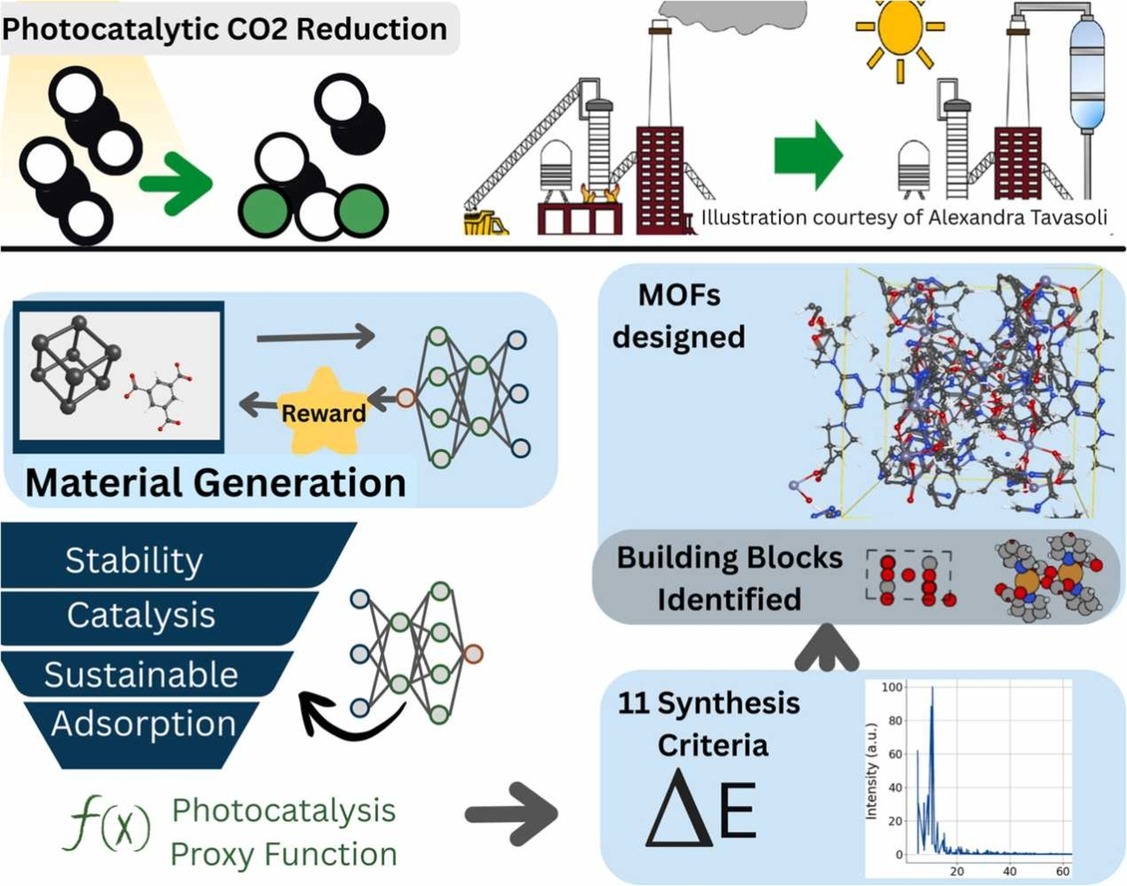
Machine learning workflows that design metal-organic frameworks for photocatalysis. Details stay brief here. The papers carry the full method and results.
Publications from this work
2026
MatCreatioNN: Machine learning-guided computational discovery of photocatalysts for environmental applications
Catalysis Today, Volume 468, 115725
2025
Machine Learning for Designing 'Undesignable' Metal-Organic Frameworks
IEEE International Symposium on Technology and Society (ISTAS), Santa Clara, CA
2025
Computational Design of Complex Metal-Organic Frameworks Using Machine Learning
3rd International Conference on Artificial Intelligence, Blockchain, and Internet of Things (AIBThings), Mt Pleasant, MI
Data and code
Training datasets and the trained CGCNN models are archived on Zenodo. The base MOF-optimized CGCNN architecture and the supporting programs for running the workflow are on GitHub.
02 / Bacterial optimization for bioremediation
Bacterial optimization for bioremediation
Engineering Alcanivorax borkumensis, a salt-tolerant bacterium that eats hydrocarbons, into a chassis that degrades both oil and plastic. Completed project, run at the University of Delaware from December 2024 to October 2025, awarded a gold medal at iGEM.
- Where University of Delaware
- When Dec 2024 to Oct 2025, completed
- Result iGEM gold medal
The problem
Millions of people depend on marine ecosystems for food, income, and daily life. Thousands of oil spills happen in the United States every year. They destroy habitats, poison food supplies, and harm human health. Documented effects of exposure include reduced lung function, heart attacks, memory loss, and confusion.
This is local. Last year, over 3,500 liters of oil spilled into the Christina River Basin at the Port of Wilmington, a 15 minute drive from our school. That basin supplies over 300 million liters of drinking water each day to half a million people.
Existing cleanup methods all carry a cost. Absorbent materials are hard to dispose of and can harm marine life. Booms and skimmers are slow and depend on currents and spill size. Burning oil pollutes the air and leaves oily residue in the water.
Why this bacterium
Alcanivorax borkumensis is halophilic and hydrocarbonoclastic. It evolved to thrive in oil-contaminated water, and its population rises naturally after a spill. It degrades alkanes using alkane monooxygenases, cytochrome P450s, and biosurfactant pathways. It tolerates salt, handles long-chain hydrocarbons, and cultures easily without complex nutrients.
Plastic is the harder half of the problem. Polyethylene resists natural degradation, and few microbes touch it. Studies of the mealworm gut microbiome point to bacteria that can. Comparing those microbes against the native machinery of A. borkumensis opens a path to one organism that handles both pollutants.
Approach
- 01
Identify the enzymes
Candidate enzymes were selected from proteomic data and alkane degradation literature, expressed in E. coli, then verified with SDS-PAGE and western blotting. Structural modeling confirmed functional relevance.
- 02
Confirm native degradation
Assays measured biofilm formation on hydrophobic surfaces and growth on oil or plastic as the only carbon source. FTIR spectroscopy confirmed oxidation products and carbonyl formation on polyethylene.
- 03
Engineer better performance
Conjugation and broad-host-range plasmids introduced genes that assist plastic degradation. Antibiotic resistance markers flagged successful transformation, and repeat biodegradation tests quantified the gain.
2025 iGEM wet lab work
The team built a full pipeline for expressing, purifying, cloning, and characterizing alkane-degrading enzymes. Early work covered media and antibiotic stocks, plasmid prep, transformations into several E. coli strains, and cultivation of A. borkumensis.
Expression studies ran across multiple constructs and conditions using IPTG induction in BL21 strains. Growth was tracked by OD600. Proteins were extracted by chemical lysis, split into soluble and insoluble fractions, quantified on Nanodrop, and analyzed by SDS-PAGE, including standard LB against sorbitol-supplemented media.
Additional candidates followed: PHB, YxeP, P450, BeSA, Lipase SK2, Lipase24, and AlmA. His-tag affinity chromatography handled purification. When western blots failed to detect the target, the team added PelB secretion signals and SUMO and MBP solubility tags.
Cloning took the largest share of the work. Gibson Assembly integrated PelB and SUMO tags into PHB and AlmA vectors. That required primer design, PCR optimization, gel electrophoresis, DNA extraction, gel purification, restriction digest validation, and sequencing.
Parallel studies characterized Alcanivorax isolates from mealworm gut microbiomes, comparing biofilm formation, biomass, and growth behavior. Purified enzymes then went through oxygenase activity assays on hexadecane with NBD-hydrazine fluorescence detection.
Full documentation of the project lives on the team wiki: 2025.igem.wiki/csw-ud.

- Organism
- Alcanivorax borkumensis
- Lead enzyme
- AlmA, a flavin-binding monooxygenase
- Targets
- Crude oil alkanes and polyethylene
- Methods
- Gibson Assembly, His-tag purification, FTIR, NBD-hydrazine assay
- Context
- 2025 iGEM season, gold medal
- Site
- University of Delaware
- Dates
- Dec 2024 to Oct 2025, completed
Finding: AlmA looks like the strongest candidate for the first oxidation step in alkane degradation. The work also lays a base for a wider genetic toolbox in a species that has almost none.